



Powering the Future: Electrification as the New Normal for Straddle Carrier Operations
Executive summary
The electrification of straddle carriers has moved from pilot projects to commercially credible full-scale deployments. Advances in battery and charging technology are converging with several other industry trends to reduce the technical and business risks of electrification, enabling terminal operators to begin transitioning to electric fleets with minimal operational impact.
The total cost of ownership of battery-electric straddle carrier operations is becoming increasingly attractive compared to hybrid or diesel-electric solutions. Terminals that have begun their electrification journeys are finding that electric straddle carriers provide them with a compelling business case and a clear roadmap for the future.
Battery-electric technology introduces a new operating profile that requires the integration of charging breaks into straddle carrier operations. The choice of charging strategy is a key technical and operational decision, and for most terminals, the optimum charging solution will likely involve a mix of strategies. The most promising and flexible charging strategy for electric straddle carriers currently appears to be a combination of depot and opportunity charging.
The electrification of a straddle carrier fleet is a complex endeavour that needs to be planned with a structured multi-stage process. The result of this iterative planning is a fully validated electrification roadmap that minimises risk, optimises investments, and accelerates the transition to cleaner, smarter and more efficient straddle carrier operations.
Moving from diesel to electric straddle carriers reduces both operating costs and the terminal’s environmental footprint, while improving predictability and compliance with tightening emission regulations. Simulation and emulation tools provide crucial insights in the planning phase by modelling different deployment scenarios, charging strategies and the total cost of ownership over time.
Finally, piloting electric straddle carrier operations is generally very easy and can be begun even while the full electrification strategy is still in development. In most cases, the electric machines can be slotted into the existing operation with almost no changes to operational planning. These hands-on experiences serve as the ideal basis on which to then develop the long-term electrification roadmap for the terminal.
2 Background, trends and investment drivers
The global container handling industry is at a turning point: electrification is no longer a distant ambition, but a critical step toward achieving sustainable, resilient and cost-efficient operations. As ports and terminals face mounting regulatory pressures, stakeholder expectations and the urgent need to cut emissions, electrification offers a clear pathway to both environmental responsibility and long-term competitiveness.
This white paper is intended to provide a general overview of the current state of container terminal electrification, when considered from the point of view of horizontal transportation equipment. The paper focuses particularly on charging strategies for manually operated and automated straddle carriers, but many of the basic principles will be applicable to other types of container handling equipment as well. Since quay and yard cranes have already been mostly electrically powered for many years, they are omitted from the scope of this discussion.
The publication builds on the foundations laid in Kalmar’s earlier white papers including Road to Zero, outlining the industry’s decarbonisation journey, and Designing Future-Proof Terminals, which explored strategies for operational adaptability in a changing world.
Electrification offers up to 90% reduction of equipment lifetime emissions
Did you know that the lifetime emissions of an electric straddle carrier is 90% lower than that of a diesel straddle carrier if being charged with emission free electricity?
Industry trends in terminal electrification
At the time of writing (mid-2026), the electrification of straddle carriers has moved from pilot projects to commercially credible full-scale deployments. Advances in battery and charging solutions, growing product offerings, and expanding public funding for zero-emission infrastructure are converging to reduce the technical and business risk, enabling terminal operators to begin transitioning to electric fleets with minimal operational impact.
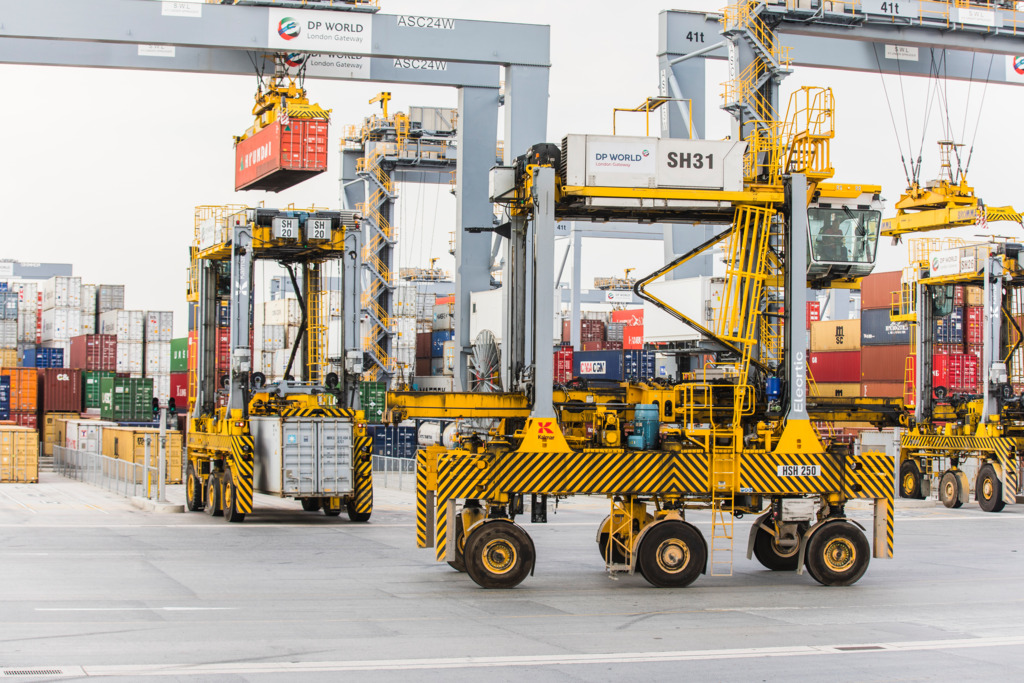
Over the last few years, electric straddle carriers have decisively become a realistic production solution. Forward-looking terminals such as DP World London Gateway that initially began their electrification journeys with small-scale pilot projects have now found that electric straddle carrier fleets have provided them with a compelling business case and a clear roadmap for the future.
At the same time, multiple charging and battery strategies including depot, opportunity and mixed-mode smart charging are seeking and finding their place in terminal-level solutions. Decisions made today must balance capital costs, grid capacity and operational needs, while fitting in with the terminal’s long-term fleet renewal strategy.
Driving down TCO with electric straddle carriers
The total cost of ownership makes battery-electric straddle carrier operations an increasingly attractive alternative to traditional hybrid or diesel-electric solutions. This is driven by a confluence of market momentum and new technical enablers.
Firstly
The straddle carrier market is seeing fresh vendor activity and more electric machine models entering the market – a sign that OEMs and integrators are committed to product portfolios for all-electric terminals. As an example, Kalmar has committed to having a minimum of one-third of its horizontal transportation equipment sales from electric models by 2028. Member companies of industry organisations such as the Zero Emissions Port Association (ZEPA) have made public commitments for the purchase of large numbers of electric straddle carriers over the next decade.
Secondly
Alongside rapidly developing battery technology, high-power charging standards are enabling very fast, high-energy transfers for heavy equipment. New charging architectures such as the Megawatt Charging System (MCS) – introduced by Kalmar for straddle carriers in 2025 – facilitate flexible opportunity charging while shortening the charging times for high-use assets.
Thirdly
Policy and funding tailwinds are providing additional support for electrification. Large, centralised programs including Alternative Fuels Infrastructure Facility (AFIF) grants in the EU and national funds elsewhere have been directing hundreds of millions of euros toward zero-emission transport and charging infrastructure, lowering the effective capital burden on ports and improving payback scenarios.
3 Charging strategies
A key consideration for straddle carrier electrification is the choice of charging strategy for the machines. Straddle carrier operations at container terminals have been generally designed for traditional diesel-electric or hybrid machines that enable a full shift’s operation without refuelling.
Battery-electric technology introduces an alternative operating profile that typically features a maximum operating time of around 8 hours, so charging needs to be integrated into continuous terminal operations. As a result, any battery-electric straddle carrier solution will need to select a charging strategy that strikes the optimum balance between total cost of ownership, fleet performance and operational constraints.
The choice of charging strategy can easily be perceived as merely a technical choice between several alternative solutions, but it is a much broader question that ties into the overall strategy, operating environment and business goals of the terminal. However, in the early stages of piloting, the exact choice of charging strategy is not critical, and terminals can easily begin exploring the benefits of electrification while refining their charging concept based on the real-world experience they have gained.
At the time of writing, there are three main charging strategies that are relevant for straddle carriers. These are depot charging, rotation charging and opportunity charging, each of which will be summarised briefly below.
It is important to note that the choice of the best charging strategy will depend greatly on the individual operational profile of the terminal. Moreover, the strategies outlined below are not mutually exclusive, and the optimum strategy for a terminal may well involve a combination of elements from multiple strategies.
All the charging strategies are relevant for both manually operated and automated straddle carrier terminals; however, certain strategies may be better suited for one or the other. For example, automated terminals will be able to realise the full potential of opportunity charging better than manual operations, since the automation system can re-assign machine jobs and charging tasks significantly faster than would be possible with manually driven straddle carriers.
Depot charging
Definition
Scheduled, overnight or off-shift charging at a centralised depot during fixed or staggered breaks in terminal operation.
In many ways, depot charging can be considered the theoretically optimum way of charging an electric straddle carrier fleet. In this strategy, charging takes place during pre-planned times such as lunch breaks and shift changes. As charging speeds increase in the future, the time needed for charging the machine will decrease correspondingly.
In practice, the feasibility of depot charging depends greatly on the operational concept and work shift pattern of the terminal. For a fleet of straddle carriers, the technically ideal solution would be to stagger the charging breaks so that all the machines are not charging at the same time, in order to even out the peak loads on the electrical grid. However, this is often not possible due to pre-existing work shift arrangements or other operational patterns, but depending on the specifics of the terminal, depot charging may offer a simple and easy-to-realise charging strategy that requires minimal changes to existing terminal infrastructure and operational processes.
Benefits
- Can be implemented as an initial step and later integrated into a mixed charging strategy (e.g. combined with opportunity charging)
- Predictable energy scheduling
- Simpler grid connection design
- Easier to pair with on-site renewables and stationary storage.
Key trade-offs
- Requires larger batteries on machines (higher battery CAPEX) or additional spare units to cover full-shift operations
- Requires more chargers
- Depends on predictable time windows when machines can be charging and non-operational
- May require staggering of break times, so possibly incompatible with existing work schedules at manually operated terminals.
Charging with CCS/MCS during the mandated operator breaks1
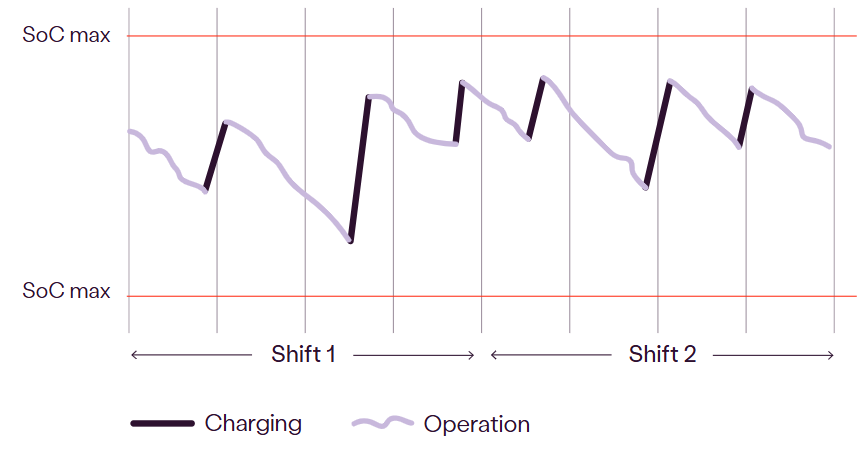
1) Modelled with CCS charging and 50 kWh/h average consumption. Charging speed will vary depending on the charging method, with MCS enabling faster charging than CCS.
Rotation charging
Definition
When battery levels are low, the machine is brought to the charging station and is replaced by another fully charged machine.
Rotation charging is arguably the simplest of the charging strategies, and it also provides the most stable load profile on the power grid. The system is compatible with 24/7 operations, requires no changes to existing shift patterns and results in minimal equipment downtime due to charging.
The principal trade-off is that more machines are needed when compared to a traditional fleet of given size. The exact numbers will vary depending on the specifics of the terminal operation, but typical calculations for real-world terminals indicate that 10–20% additional machines will be required.
For a terminal operator, this is a nontrivial increase in required capital expenditures; however, it is important to note that each machine in the larger fleet will accrue proportionately fewer operating hours over a given period, so the operating life of the machines should be commensurately longer, at least partially offsetting the larger capital investment over time.
The larger required fleet size also creates additional demands on the terminal beyond the actual charging of the machines. Parking space and service facilities must be available for the extra straddle carriers, and the driving distance from the charging location to the operational area must be manageable. As a result, rotation charging is likely to be most practical for terminals with medium-sized straddle carrier fleets.
Benefits
- Minimal additional operational downtime from charging-related activities
- Flat electricity demand profile without major peaks
- Technically the simplest charging strategy
- Supports 24/7 operation with no changes to shift patterns
- Enables greater flexibility to optimise charging timing, for example based on electricity prices.
Key trade-offs
- Requires extra machines in the fleet since a fixed percentage of them will be charging at any given time
- Additional space and facilities are needed for the extra machines.
Charging with CCS/MCS according to the rotation schedule2
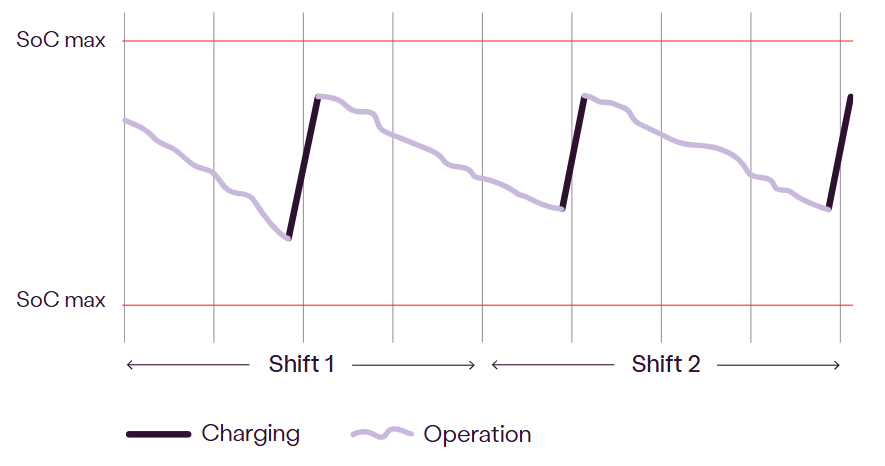
2) The illustration of the charging cycle has been modelled with CCS charging and 50 kWh average consumption. Charging speed will vary depending on the charging method, with MCS enabling faster charging than CCS.
Opportunity charging
Definition
Short, high-power charge sessions during operational breaks or while machines are waiting (e.g. at gates, working areas or scheduled stops).
All manual and automated straddle carrier operations inevitably include moments in which the machines are not engaged in an active work task. The idea of fast opportunity charging is to use these waiting times to charge the machine in short and frequent charging sessions with charging stations that are placed at easily accessed locations in the operating area. For this reason, opportunity charging may also be attractive to terminals that have a particularly long driving distance from the equipment depot to the operating area.
Opportunity charging will, by default, require a hands-free charging interface that does not need an operator to connect and disconnect the charging connector. Kalmar’s pantograph-based FastChargeTM interface already enables rapid charging at megawatt-level power, while an automated version of the MCS interface is in development at the time of writing.
The principal challenge of opportunity charging is that it requires more sophisticated planning and coordination than strategies based around centralised charging depots. In practice, charging optimisation software is needed to coordinate charging across the fleet. By making fleet-wide charging decisions, the software maximises charging station utilisation and minimises equipment waiting times beyond what is possible with manual planning or individual machine-level decision-making.
Examples of Kalmar solutions for this purpose include the Kalmar One Scheduler, which provides job scheduling, dispatching and charging task optimisation in automated terminals, and Kalmar SmartCharge, which automatically assigns charging tasks to the equipment operator at manual terminals. Both solutions are designed to avoid queues at charging stations and ensure the highest utilisation rates at equipment charging points.
It’s also important to note that for the purposes of charge scheduling, the solution does not necessarily need to wait for a moment where the machine is fully idle; instead, it can direct it to charge at the moment that is calculated to result in the least loss of productivity at the level of the entire system. Automated straddle carrier terminals hold an advantage here, as the automation system can schedule and re-schedule jobs and charging tasks for the automated machines at a pace that is far beyond the capacity (or patience) of human operators to handle.
Despite its added complexity, smart opportunity charging arguably holds the greatest potential for optimising electric straddle carrier operations with productivity that is equal to or potentially even greater than that of traditional hybrid or diesel-electric machines.
Benefits
- Allows smaller onboard batteries, reducing weight and CAPEX
- Supports 24/7 operations with shorter charge sessions
- Generally flat grid load profile (but with possible peaks)
- Can minimise number of extra machines required
- Ideal for automated straddle carrier terminals
- Can be combined with other charging methods (e.g. depot charging, rotational charging or battery swapping).
Key trade-offs
- May need high-power chargers and/or MCS-class hardware
- Requires fleet-level smart scheduling (software solution)
- Requires rethinking of operational processes; prediction of wait times can be challenging.
Charging with FastCharge/MCS during the operation3
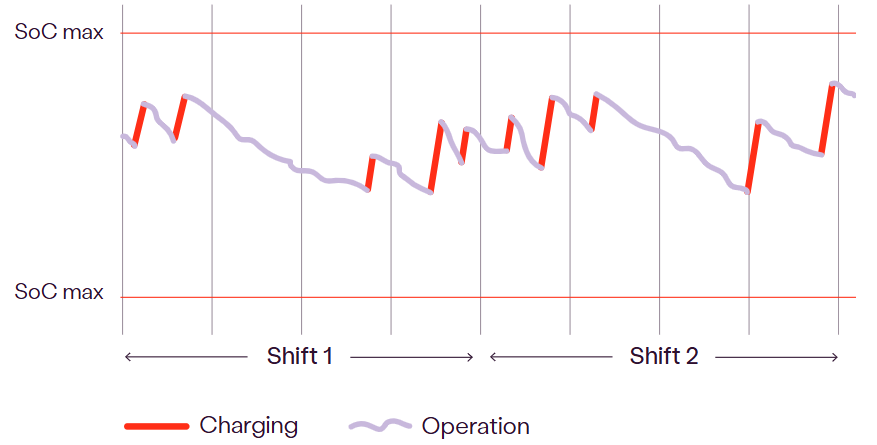
3) Modelled with Kalmar FastCharge and 50 kW/h average consumption. Illustration of the charging cycle. Total charging time 90 minutes.
Other charging concepts
As an alternative to the above strategies, battery swapping (replacing a discharged battery pack with a charged pack via automated or manual swapping stations) has been used for some types of electric equipment, most notably Automated Guided Vehicles (AGVs). In principle, battery swapping offers several advantages including minimal downtime from charging and smaller onboard batteries. However, as the system relies on centralised swapping stations, potential disruptions (e.g. technical malfunctions or safety incidents) could impact a significant portion of the fleet, which may require consideration of redundancy measures. As no battery swapping solutions are currently available for straddle carriers, the concept is not explored further in this publication.
Mixed charging strategies
It is important to note that the charging strategies outlined above are not mutually exclusive. In fact, drawing on real-world experience from customer sites around the world, as well as simulation insights using real operational data, the authors of this paper consider that for most electric straddle carrier terminals, the optimum charging solution will involve a mix of strategies. At the time of writing, the mixed strategy that appears to hold the most promise is a combination of depot and opportunity charging.
Any plan for charging electric straddle carriers must also consider the total picture of energy usage at the terminal. Depending on the type of equipment, some or all of the charging infrastructure for straddle carriers may be utilised for other types of terminal equipment as well. For some terminal operators, the grid loads imposed by the simultaneous charging of multiple electric straddle carriers may pose a significant challenge; for others, the additional peak loads might fade into insignificance alongside ongoing initiatives for providing shore power for large container vessels.
Charging with CCS/MCS during mandated operational breaks
and ‘top-up’ charging with FCS/MCS during operation
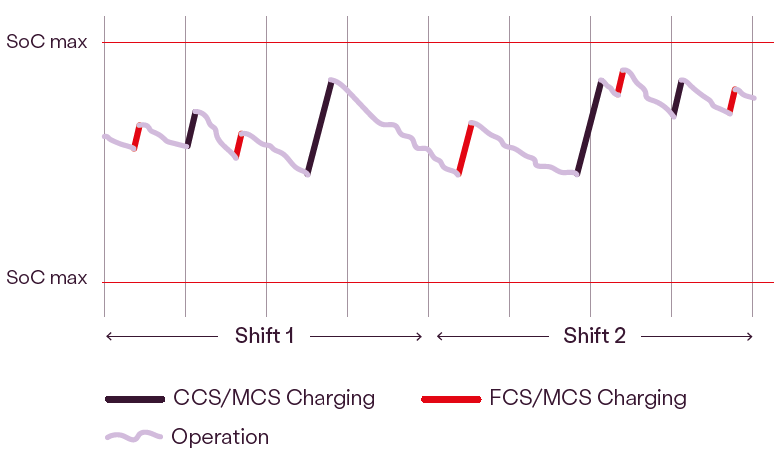
Modelled with 40 minutes of break time during a shift, CCS + FastCharge charging and 50 kW/h average consumption. Total charging time 110 minutes. Charging speed will vary depending on the charging method, with MCS enabling faster charging than CCS.
Megawatt charging: The game changer
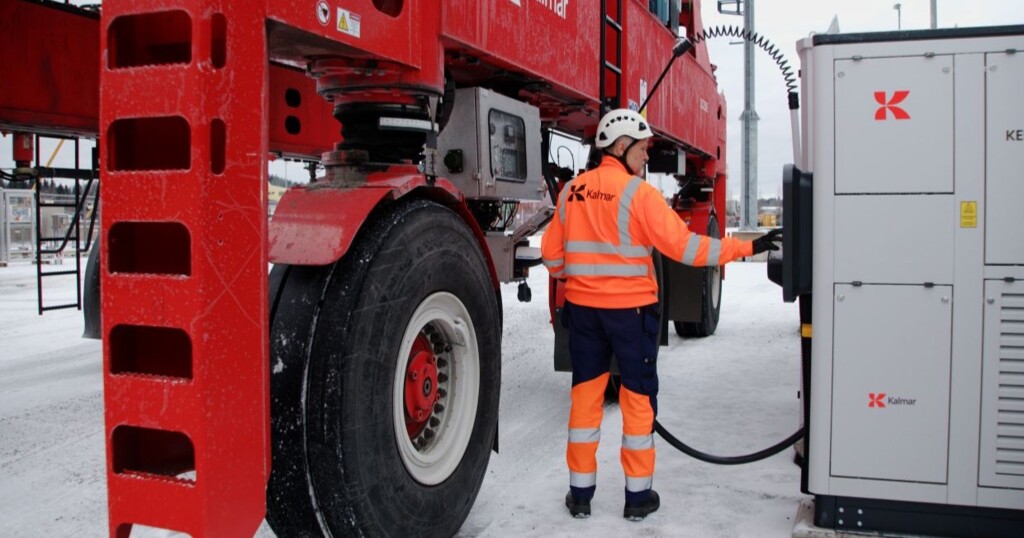
Megawatt Charging Systems (MCS) that can deliver multi-hundred-kW to multi-MW bursts are currently making their way from heavy road trucks to container handling equipment. Kalmar announced the first MCS for straddle carriers in 2025, and an automated version of the solution is currently in development.
Megawatt-level charging holds great promise for electrification of terminal operations, as it reduces dependence on individual machine battery size, enables opportunity charging at higher power levels, and makes very short charge windows technically feasible. Key industry initiatives position MCS as a backbone for heavy-duty machine electrification.
As charging solutions and batteries evolve to utilise the maximum specified capacity of the MCS interface (up to 3.75 MW charging power), terminal operators will have significantly more flexibility to choose a charging solution that fits their individual operating profile. For example, in the future MCS could make depot charging viable without the need for staggered work shift patterns.
4 The electrification journey
Electrifying a straddle carrier fleet is not a single decision – it is a journey. At Kalmar, electrification is planned with a structured process designed to reduce uncertainty, maximise return on investment, and ensure that the final solution is both technically and operationally robust.
The planning part of the journey consists of four key phases: Investigate, Qualify, Demonstrate and Re-Qualify.
Investigate: Understand the landscape
The first step is a detailed investigation of the terminal’s operational profile and physical environment. This includes analysing terminal layout options, the transition phases, duty cycles, peak workloads, energy demand patterns and other operational requirements. Critical requirements such as throughput targets, equipment productivity, grid capacity, automation level, and sustainability commitments are identified. The output of this phase is a set of viable pathways for electrification tailored to the customer’s specific site conditions.
This phase of the journey is also about understanding the terminal’s goals, or answering the question, “why go electric”? In practice, most electrification projects of existing straddle carrier fleets will take place incrementally as existing equipment reaches the end of its service life. The terminal may have carbon neutrality targets with a specific timeframe, so the electrification roadmap will need to concretely match these targets to the fleet renewal plan for the coming years.
Qualify: Building the business case
Once potential options are defined, they are qualified using a comprehensive TCO (Total Cost of Ownership) analysis. This covers CAPEX (new machines, retrofits, charging infrastructure), OPEX (energy costs, maintenance savings, labour impact), and the return on investment over the lifecycle of the investment.
Different scenarios – such as retrofitting existing straddle carriers vs. purchasing new electric machines – are compared, and funding or subsidy opportunities are factored into the financial model. The outcome is a clear, data-backed understanding of the financial viability of each pathway.
This part of the journey also involves a detailed examination of the operational model and environment of the terminal. This includes factors such as the available peak capacity from the grid, which will, in turn, affect the charging strategies that will be feasible.
Once a financially preferred concept is identified, it is verified with simulation and emulation to ensure that the solution will perform as expected. The results from this testing will then be re-input into the financial calculations in an iterative process.
Demonstrate: Validating with simulation and emulation
The simulation and emulation phase is all about validating the operational impact of the preferred concept in a digital environment. By enabling terminals to model energy demand, operational flows, and integration challenges in a virtual environment, they provide the confidence and clarity needed to accelerate the transition toward cleaner, smarter, and more future-ready port ecosystems.
This step provides answers to key operational questions such as:
- How many electric straddle carriers will be needed to maintain productivity?
- Where should charging stations be located to minimise disruption?
- What is the impact of depot charging vs. opportunity charging strategies?
- How does electrification affect fleet availability and terminal throughput?
By virtually recreating terminal conditions, simulation explores “what if” scenarios, while emulation validates the integration of the concept with actual automation and fleet management systems. This ensures that the chosen solution is not only technically feasible but also operationally resilient. Ideally, simulation and emulation will be based on operational data from the terminal, enabling various scenarios to be played out against real-world historical performance.
Simulation vs. Emulation – what’s the difference?
Simulation |
Emulation |
|---|---|
| A mathematical or digital model of the terminal environment, equipment and processes. It is used to analyse scenarios and predict performance under different assumptions such as fleet size, charging strategy, shift patterns or energy demand. | A high-fidelity digital twin that connects directly with the real terminal control software (e.g. TOS, equipment control systems, fleet management). Its purpose is to validate the operational concept and IT/automation integration in a realistic environment. |
Use cases:
|
Use cases:
|
| Key point: Simulation is about exploring possibilities and performance trends without connecting to the actual control systems. | Key point: Emulation is about replicating reality as closely as possible – not just system behaviour, but the way actual control software will manage operations. |
IV. Re-Qualify: Refining the business case
Armed with insights from simulation and emulation, the financial qualification is revisited. Updated data on fleet size, infrastructure requirements and productivity impacts are integrated back into the TCO model. This “Re-Qualify” step ensures the business case reflects the most accurate assumptions and gives decision-makers confidence that the chosen electrification strategy will deliver both sustainability and profitability.
The outcome
The result of this iterative planning process is a fully validated electrification roadmap that minimises risk, optimises investments, and accelerates the transition to cleaner, smarter and more efficient straddle carrier operations.
Electrification is rapidly emerging as one of the most impactful pathways toward sustainable and future-ready container terminal operations. Among the different equipment types in a terminal, straddle carriers represent a high-value target for electrification due to their intensive use, fuel consumption (for diesel and hybrid machines) and their central role in horizontal transport. Moving from diesel to electric straddle carriers reduces both operating costs and the terminal’s environmental footprint, while improving predictability and compliance with tightening emission regulations.
However, electrification is not a one-size-fits-all decision. Terminals must weigh the technical, financial, and operational implications of retrofitting existing straddle carriers versus investing in new electric units, while also aligning with broader fleet renewal and lifecycle planning strategies. Here, simulation and emulation tools provide crucial insights by modelling different deployment scenarios, charging strategies and total cost of ownership (TCO) impact over time.
These tools are equally valuable for automated operations, where the interaction between fleet management systems and charging behaviour must be seamless, and for manual operations, where variability in driving patterns and break schedules influences energy use. In both cases, simulation and emulation reduce risk, accelerate learning, and ensure that electrification strategies are not only technically feasible but also operationally resilient.
Emission reduction potential of the electric straddle carrier
One of the most significant benefits of electrifying straddle carrier operations is the potential for substantial emission reductions across the equipment lifecycle.
To better understand the environmental impact of different powertrain technologies, Life Cycle Assessments (LCAs) have been conducted for Kalmar electric and hybrid straddle carriers as well as their diesel counterparts. These assessments evaluate the total CO2 impact of the equipment throughout its lifecycle, including raw materials, manufacturing, transportation, energy consumption during operation, and service and maintenance requirements.
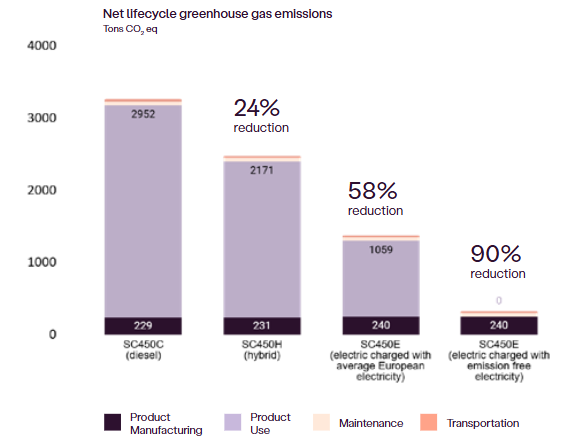
By replacing a diesel straddle carrier with a hybrid alternative, lifetime emissions can already be reduced by approximately 24%, mainly due to lower fuel consumption during operation.
The impact becomes even more significant with fully electric straddle carriers. When charged using the average European electricity mix, lifetime emissions can be reduced by approximately 60% compared to a diesel machine.
The greatest potential is achieved when electric straddle carriers are powered using emission-free electricity. In this scenario, lifetime emissions can be reduced by up to 90%, representing the largest emission reduction potential across the portfolio.
Potential lifetime emission reductions of hybrid and electric straddle carriers
5 Start small, start now
Electrifying a straddle carrier operation requires careful planning and validation; it goes far beyond replacing diesel-powered machines with battery-electric ones. Electrification is a long journey that involves finding the optimum balance between multiple factors such as operational performance, energy demand, charging infrastructure and long-term fleet renewal.
However, the good news for terminal operators is that piloting is generally very easy and can be begun even if a fully realised long-term electrification strategy is not yet available. In fact, it can be argued that in today’s business and technology landscape, any terminal will benefit from testing electric straddle carriers in order to prepare for the (inevitably electric) future.
For most terminals, the key question of which charging strategy to adopt does not really need to be answered in the beginning. Unless the terminal has a “hot seat” operation or unusually strict electricity grid limitations, it will almost always be possible to convert to electric incrementally over the next 10 to 15 years as the existing fleet is renewed.
Looking back just five – or even two – years, the pace of development in electric straddle carrier technology has been remarkable, creating new operational opportunities for terminals. We strongly believe every straddle carrier terminal should begin introducing electric straddle carriers into its operations. As the technology continues to evolve, full-scale electrification becomes increasingly practical and financially attractive. The key is to start the journey sooner rather than later.
In an electrification pilot, the key considerations will be getting used to the new technology, and understanding the use of the machines from the perspectives of operators, technicians and business planners. For small-scale pilots involving a few machines, depot charging (possibly complemented by faster megawatt charging) may offer the simplest way to integrate the electric machines into the existing operation.
Before committing to large-scale investments in electric straddle carriers, terminals need confidence that the chosen operational concept – fleet size, charging strategy, and infrastructure layout – will perform reliably under real conditions. Through simulation, planners can evaluate key factors such as duty cycles, energy demand, charging windows, and throughput impacts, while emulation allows integration of actual control systems and automation logic to verify performance in a realistic environment.
Real-world feedback from terminals that have begun their electrification journey with small-scale pilots indicates that in most cases, the electric machines can be slotted into the existing operation with practically zero effect on operational planning. These hands-on experiences serve as the ideal basis on which to develop the full electrification roadmap for the terminal – and from which to take next practical steps toward that envisioned future.
Appendix: Understanding the TCO of electric straddle carriers
Benefits |
Challenges |
|---|---|
| Lower operating costs: Significant reduction in fuel and maintenance costs compared to diesel units | Higher upfront investment: Both retrofits and new units require significant capital, especially when combined with charging infrastructure |
| Emission reductions: Immediate cut in local pollutants and CO2, supporting sustainability targets and regulatory compliance | Infrastructure dependency: Requires careful planning for power supply, grid upgrades and charging points |
| Energy price stability: Electricity prices are generally more stable and predictable than fossil fuels | Operational adaptation: Charging cycles and range limitations may necessitate changes in shift planning or workflows |
| Enhanced efficiency through digitalisation: Electric fleets integrate seamlessly with energy management systems, enabling smart charging and load balancing | Retrofit technology maturity: Retrofits may have shorter lifespans or performance constraints compared to new electric machines |
| Future-proofing: Prepares terminals for long-term decarbonisation strategies and stakeholder demands for greener logistics. | Residual value uncertainty: Market values for retrofitted units may be less predictable than for factory-built electric machines |
About the authors

Marko Hopeaharju
Director, Innovation and Product Management, Kalmar
Marko Hopeaharju is Director, Innovation and Product Management at Kalmar and has worked with the company for over 30 years. He brings to his role extensive experience in business and product management, R&D and engineering, automation and integration, sales with global customers and electrification. Throughout his career, Marko has held various management roles driving the growth of container handling equipment, automation solutions and sustainable innovations in a continuously evolving container handling industry.

Sami Yli-Äyhö
Senior Manager, Product Management, Kalmar
Sami Yli-Äyhö is Senior Manager, Product Management at Kalmar and has been with the company for almost 20 years. He is an experienced R&D leader with a strong track record in the machinery industry, skilled in engineering management, project and program management, and product development. Throughout his career, Sami has successfully led teams and projects driving innovation and development in Kalmar’s equipment and solutions.

Mette Kjems Bærentzen
Director of Decarbonisation, Kalmar
Mette Kjems Bærentzen is Director of Decarbonisation at Kalmar, where she leads the company’s efforts to reduce emissions across Kalmar’s products and global operations. She supports the implementation of low-carbon technologies while building cross-industry partnerships that help ports and terminals accelerate their transition toward more sustainable operations.

Kivi Siik
Sales and Business Development Specialist, Terminal Design Services, Kalmar
Kivi Siik is Sales and Business Development Specialist at Kalmar. As part of the Terminal Design Services team, he supports both brownfield and greenfield terminal modernisation projects, many of which focus on electrification and automation. With a background in business, Kivi focuses on helping customers identify the financially optimal solution for their terminal modernisation.
Disclaimers
The goal of this paper is to provide a brief overview of lithium-ion battery technology for a non-technical professional readership in the logistics and cargo handling industries. The white paper represents the opinions of the authors, and is the product of professional research. Kalmar can not be held liable for how the information in the white paper is used. The information included was current at the time of writing (January 2026).
Related articles
Further reading
Customer case
Subscribe and receive updates in your email
Subscribe to our publications