



The Human Side of Innovation: Meet Ilari Kampman
Innovation doesn’t start with technology. It starts with someone willing to try.
Every innovation has two sides: the undeniable technical achievement and the measurable impact. But equally important is The Human Side. The one who dares to try, tests uncertain ideas, fails and tries again, and challenges “the way we’ve always done it”. It’s about curiosity and courage. This article series celebrates Kalmar colleagues who live our core behavior, Experiment.
In this feature, we celebrate Ilari Kampman, Lead Data Scientist at Kalmar, an Innovation Role Model and a co-winner in the 2025 Kalmar Innovation challenge, who truly shows us what Experiment looks like.
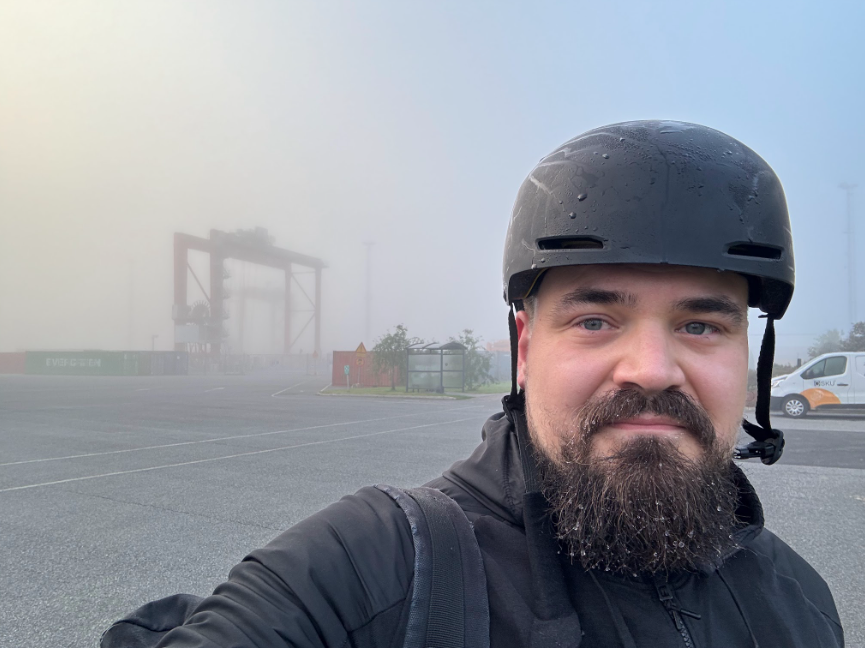
Image: Ilari and the morning mist at Kalmar Innovation Center in Tampere
Let’s ask Ilari to share his insights on innovating.
What originally drew you to this industry and job?
I studied in the Science and Engineering degree programme at Tampere University of Technology, majoring in mathematics. Initially, I planned to become a teacher for mathematics, physics, and information technology. After teaching for a while, I realised it wasn't the career path I wanted. My passion was to focus on specific topics and solve challenging engineering problems, so I redirected my studies toward theoretical computer science and advanced computation.
The true appeal for me was using programming to solve complex mathematical problems. In 2014, I discovered the title ‘Data Scientist’ and knew it was the right role for me. In 2020, I joined Cargotec to focus solely on data science, which eventually led me to my current role at Kalmar.
What motivates you to innovate?
My greatest motivator is creative problem-solving starting with the question: ‘What is the real problem?’ That, to me, is true innovation. When I can formulate questions that uncover the core challenge and apply mathematics to solve it, it makes my work incredibly fulfilling and drives my passion to push boundaries.
I believe it’s important to have some freedom and creativity to truly enjoy your work. Creativity is a key element for me. I aim to use it both at work and in my free time. While mathematics and programming may seem highly structured, they are merely tools for the fundamental creative thinking process that drives my passion.
Can you share an example of innovation you've developed?
When I joined the company back in 2020, the first topic I started to research was the ability to model parts lifetime in our customer operations using our operational data. Two years of dedicated data science work and cross-functional collaboration culminated in the launch of iRecommend, a proactive parts recommendation feature that has been enriching the MyKalmar STORE experience for the past three years by helping customers identify relevant genuine parts, supporting timely maintenance and replacement activities, simplifying purchasing decisions, and ultimately minimising downtime.
Many iterations later, iRecommend continues to evolve. It's a great reminder that innovation is often about getting something off the ground and putting it to work.
How do you see the importance of innovations and experimenting in general?
As a data scientist at Kalmar, my job is to find smarter ways of doing things and discover new opportunities that keep us at the technological forefront of our industry. To me, that’s innovation. Experimentation is the only way to test whether those ideas will actually fly. It might sound obvious, but to be creative, you have to block out uninterrupted time for it—regularly. If innovation is a priority, protecting time for creative experimentation is where it all starts.
Looking ahead, even our best solutions today will eventually become obsolete. Without the creative thinking and experimentation we do right now, there’s nothing to propel us into tomorrow. But real experimentation means accepting failure—and more importantly, documenting it. A failed test often isn't a bad idea; it’s usually just a method or technology that wasn't mature enough yet. When we document and share those lessons openly, we keep good ideas alive for when the technology catches up. That kind of transparent communication and collaboration broadens our collective perspective, sparking new thoughts across the team and encouraging everyone to contribute.
What advice would you give to future innovators?
- Focus on areas that are naturally familiar or interesting to you.
- Identify improvements in your current work that strategically benefit the company.
- Remember that even small ideas can be the starting point for a major change.
- Discuss with people with different backgrounds and make friends.
Related articles
Subscribe and receive updates in your email
Subscribe to our publications